

Fung Shui: Dr. Jason Fung Cracks ‘The Hunger Code’
“Resetting Your Body’s Fat Thermostat in the Age of Ultra‑Processed Food”
One day, a few years ago, a dear friend (Greg Greiner) and I were discussing the various diets we’d tried over the years. Greg told me that he had once attempted a scheme with a female co-worker, called the “Champagne and Caviar Diet.”

For the first three days, they polished off his best champagne and gobbled up his expensive caviar. But by Day Four, besides feeling a bit queasy, Greg realized his budget couldn’t sustain this regimen unless he switched to Brut Rosé and Lumpfish, so he bailed before it got tragic. Still, he was quick to point out that the program had worked – it was the tastiest diet he had ever been on, and he did lose a few pounds as well.
As you can probably tell, I’m no stranger to the mantras of diet and exercise. Over the decades — starting in my twenties and continuing to the present day (don’t ask!) — I’ve probably read well over a hundred volumes on weight loss, nutrition, metabolism, and whatever trend was sweeping the nation that year. I’ve cruised with Richard Simmons, lost forty pounds on Weight Watchers, and, in a plot twist no one saw coming, was once Weight Watchers Leader of the Year for my region. You could say I’ve conducted a lifelong study of diet culture, or you could say I’ve been overly fixated on my weight and health — like many of us — which is probably closer to the truth.
I’ve experienced them all: Jim Fixx’s running books, Dr. Phil’s pep talks, Richard Simmons’ boundless enthusiasm, sunning on South Beach, supping like a Mediterranean, and every other shiny new promise that came down the pike. I’ve counted points, calories, macros; juiced fruit and kale (ack!); sucked on cabbage soup; started each day with a grapefruit (can’t even look at those suckers anymore); and even abstained from sugar for long stretches (I always returned to my true love, though). Sadly, every single time, I believed — nay, swore unfettered allegiance to — each book, each diet, each new plan. Hope sprang eternal that what I was being told would “fix” me was the gospel truth. Looking back, I’m not sure whether I was too naïve, too trusting, or simply hoodwinked by the endless parade of pseudoscientific fads.
So, when I picked up Dr. Jason Fung’s new foray into the “diet” world, The Hunger Code: Resetting Your Body’s Fat Thermostat in the Age of Ultra‑Processed Food, I felt that familiar flicker of hope for weight-loss salvation. A longed-for beacon of light (and lightness) at the end of the labyrinthine tummy tunnel. I turned to those first few pages with a fierce determination to avoid once again being seduced by false promises. This time, I would maintain a cynical eye on the information being proffered.
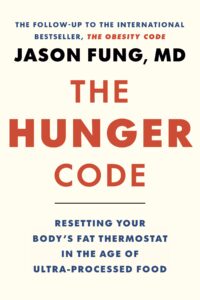
What struck me immediately about The Hunger Code is that it isn’t a diet book in the traditional sense — and Dr. Fung is very clear about that. This book is a direct follow‑up to his bestselling The Obesity Code, and it’s not another list of rules, restrictions, or branded meal plans. Instead, he returns to the kind of common‑sense wisdom that has guided healthy cultures for generations: eliminate ultra‑processed foods (UPFs) as much as possible, fast intermittently, and build the social connections that make long‑term change possible. It’s refreshingly simple, but not simplistic. In other words, eat like your grandparents ate, and you’ll be fine. If you can’t trust Granny, who can you trust?
Where The Obesity Code focused heavily on insulin, cortisol, and the hormonal drivers of weight gain, The Hunger Code widens the lens. Here, Dr. Fung digs into the “body fat thermostat” — the internal system that regulates hunger, satiety, and energy storage — and then examines all the modern forces that disrupt it. UPFs, food addiction, emotional eating, social isolation, and the constant availability of hyper‑palatable snacks all play a role in pushing that thermostat higher and higher. The result? We’re hungrier than we should be, eating more than we need, and beating ourselves up in the process.
Dr. Fung breaks down hunger into three categories: homeostatic (true physical appetite), hedonic (pleasure‑fueled cravings), and contextual (habit‑based environs). He doesn’t pretend this desire for food can be conquered, eliminated, or bullied into submission. Rather, he empowers each of us to become the CEO of our urges to eat. Managing appetite puts you in the driver’s seat, steering the focus away from willpower, calorie counting, and deprivation. Instead, you can build habits that harness your biology rather than wage war against it.
Dr. Fung doesn’t just describe the problem; he has solutions as well. There are three pillars to the good doctor’s prescription: First, avoid frankenfoods, those genetically modified monsters with unpronounceable ingredients and a far longer shelf life than our New Year’s resolutions. Secondly, those who are already familiar with his work will not be surprised to find intermittent fasting given serious consideration here. And finally, our social and home environments — are they setting us up for success or sabotage?

I have read many of Dr. Fung’s other “Code” books and have found them to be fascinating but also a bit dense. Here, he seems to have learned the art of gracefully dumbing down complex information into useful metaphors and lucid illustrations, while extending fun, handy hints throughout.
Dr. Fung grounds the reader in science and clarity. He doesn’t sugarcoat the effort involved. His message is plainspoken: weight loss may seem hard, but it can be accomplished. You don’t need government oversight, pharmaceutical interventions, or a $500-a-month meal plan to get there. Your best allies might just be common sense, consistency, and a willingness to try something different.
In the aftermath of reading this book, I have found myself making small tweaks and building better habits. Rather than skydiving into yet-another “New Year, New Me” diet, this book gently altered my perspective in a meaningful way. It helped me ease up on myself and address what Dr. Fung calls the questions of weight loss — who, what, when, where, why, and how — without obsessing over them. I’ve moved from trying to “fix” myself to kindly “managing” myself; a subtle yet profound paradigm shift.

And if a book can do that for someone who has read over a hundred nutrition tomes, what might it do for you?
The Hunger Code is the rare health read that works on multiple levels: it’s a guide, a reference, a mindset, and a reality check. It’s a resource you’ll want to keep on hand whenever you need redirection, grounding, or focus. And sometimes you’ll reach for it simply to remind yourself that your body isn’t broken; it’s responding exactly as it was designed to in a world that has changed far too quickly.
If you’re looking for a post‑holiday reset, a New Year’s resolution that actually makes sense, or simply a saner way to think about food and hunger, this is the book to pre‑order. Think of it as a belated Christmas gift for yourself. It’s smart and down-to-earth; quite possibly the most compassionate and practical health book you’ll read this year. It might just be the last “diet” guide you’ll ever need.
The Hunger Code: Resetting Your Body’s Fat Thermostat in the Age of Ultra‑Processed Food, by Jason Fung, MD, will be published by Greyston Books on March 3, 2026. The hardcover edition (6″ × 9″) is priced at $29.95 US.

Lisa Salkov is a quizzical Renaissance woman — paralegal, actress, award-winning playwright, journalist, editor, loyal friend, and cat fancier. Above all, she is a soprano who thrives in sacred spaces. Lisa follows her curiosity wherever it leads — health and wellness, philosophy, religion, humor, and the human condition. As she gracefully enters yet another season of life, Lisa is grateful to care far less about the things that never really mattered.