Sand Historian’s Tribute Plaques Pair Battle Maps with Remembrance Bottles
Ernie Pyle was not the first war correspondent to observe the apparent obsession American servicemen had with collecting war souvenirs. Pyle’s quote on this phenomena in his book, The Brave Men, is actually attributed to an unnamed soldier. And savvy readers will note that that soldier’s remark recalls a similar jibe at WWI’s doughboys. Even so, a distinction must be made between the brassards and bayonets scrounged by the duffle bagful, and the modest keepsakes which acted as solemn reminders of the thin line between life and death.
Joel Johnson – a former law enforcement officer and financial planner from Aiken County, South Carolina – was not yet born when the Greatest Generation was giving their all during WWII. In fact, Joel’s interest in the war began more than a decade after the conflicts ended – when around age five, he received his first Marx Toys Army set for Christmas. Today, that childhood interest has grown to include an extensive collection of WWII weapons, research and reference books, memorabilia, and detailed maps. And, like Ernie Pyle, Joel has crisscrossed the globe documenting America’s wartime endeavors by walking in the shadow of the common soldier.
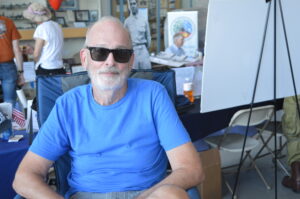
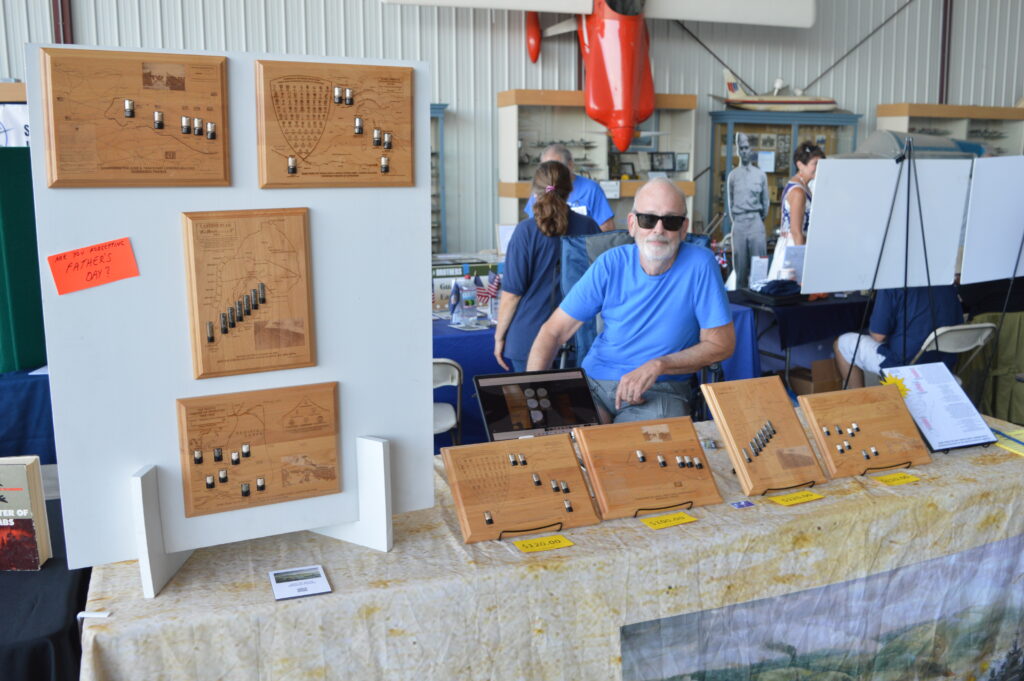
“I started this project in 2014 with a visit to Normandy,” said Joel, as we chatted by his sand displays at this years MAAM WWII Weekend. “The only initial set-back, with all of the anniversary events which were going on, was access to the beaches.”
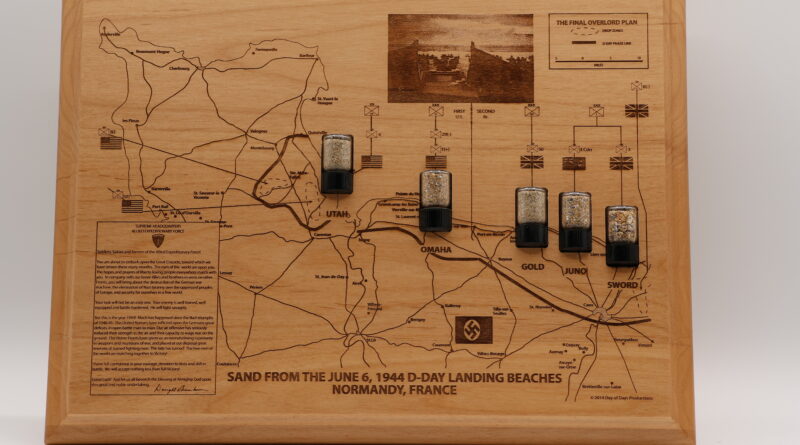
Joel’s project – a series of sand-filled vials mounted into laser engraved plaques – combines his love of maps with his interest in WWII history. Pairing the two elements, Joel has created a unique tribute to the servicemen who fought and died storming a number of beachheads, from Operation Torch in North Africa through the end of the Pacific Campaign.
“The idea for what became my company – Day of Days Productions – came to me as I was on a Delta Air Lines flight returning from Normandy. I came up with a map background, because I collect and study maps. And I had collected some sand at Normandy, so I began the process.
“All the plaques start from the Red Alder tree and are Made in the USA” continued Joel. “The Red Alder is harvested from the Northwestern coastal states. The plaques are routed out by a wood working company in South Carolina. The caps and vials, which contain the sand, are made in California.
“The plaques are lasered and assembled in South Carolina. BUT they cannot be labeled ‘Made in the USA,’ because of what makes them so special, the sand.”
Sand: From the fine coastal dunes of Morocco.
The hyper-diverse shores surrounding Sicily.
The black volcanic ash of Iwo Jima.
The dense gritty grains of Normandy.
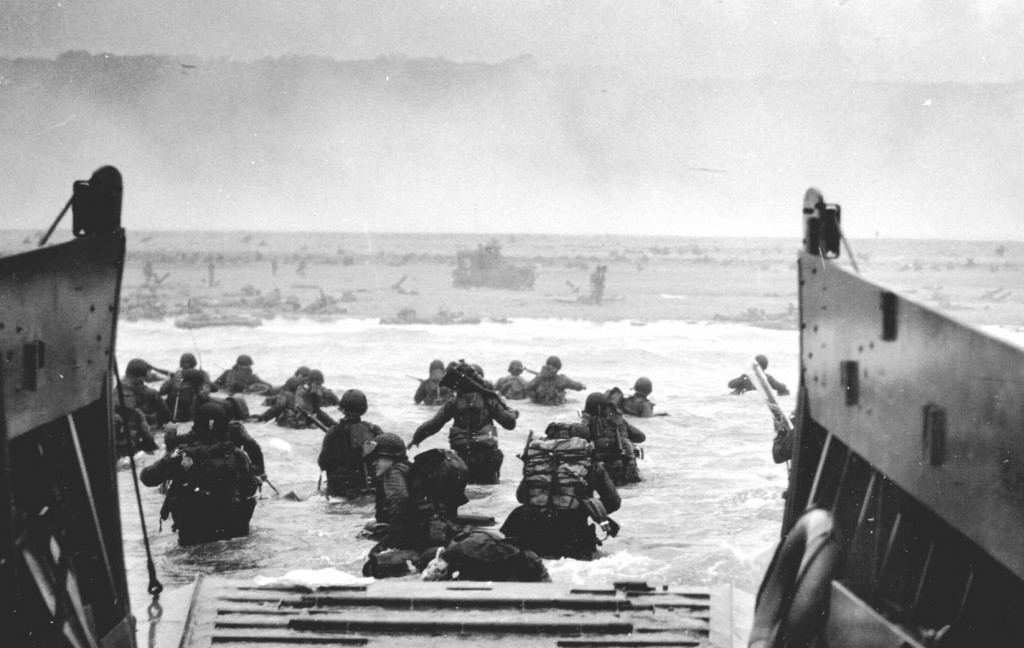
Joel told us that initially, he focused on the European Theater of Operations – specifically D-Day and the Normandy Invasion. As his project evolved, he and his wife Ute – who is from Germany – traveled extensively in Europe and North Africa to WWII sites and museums. Now Joel has expanded his WWII research into the Pacific Theater with travels to Peleliu, Palau, Guam, Saipan, Tinian and Iwo Jima; Japan, Guadalcanal, Solomon Islands, Tarawa, Kiribati and Okinawa.
“Since 2014, when I came up with my idea of the Final Overlord Plan (D-Day) plaque, I have been focused on United States Army and Marine landing beaches throughout WWII. To date I have created four sand plaques, each new plaque coming out about every three years or so, with total sales of over 3,000 plaques.
“My first plaque is the runaway best seller, due to its being the first and the most familiar invasion for most buyers/consumers. But the other three are developing an audience as time goes on. Something I had not planned on, but many times people have purchased the ‘whole set’ of plaques.”
Joel told us that his project has been extremely gratifying, but has not been without its challenges. One is finding reliable tour guides for some of the less traveled destinations.
Then there was a hiccup while traveling home from Morocco.
“When I went through the airport security, they xrayed my bag and opened it up. Security then asked me why I was packing sand, and when I told them, they said, ‘Crazy American. Why would you pack sand? There is sand everywhere!’ So I just smiled, closed up my bag and got on the plane.
“Sand isn’t dirt, so I can bring it back into the U.S. with no questions asked. But there are so many different walls that you have to be aware of when traveling.”
The ‘dirt’ wall would certainly be a big one, say, in mapping the various river crossings during the Allied invasion of Germany – particularly in breaching the Rhine. But Joel assured us that, for now, he plans on sticking with the beach assaults.
We also asked about the Aleutians, but Joel reminded us that action was actually a Japanese invasion of an American territory; similar to the Imperial conquest of the Philippines, Wake Island and Guam.
That’s not to say a relatively unknown ‘invasion’ of the continental United States was automatically ruled out.
“My research into WWII landings eventually led me into my latest plaque, the WWII United States Invasion. This turned out to be some very fascinating research, to learn all I could about these landings from the ‘inner workings’ of the German Reich intelligence planning.
“Operation Pastorius, as it was called, launched two submarines with four saboteurs each; one bound for New York and the other for Florida. Operation Elster landed two invaders in Maine. The Elster invasion was interesting in that the U-Boat traveled submerged the entire distance from Norway to Maine, which made the journey over two weeks long.
“I thought extremely long about this particular plaque. No one recalled that these landings on United States soil had taken place, but the unusual mission and intent was quite remarkable. The more I thought about it, the more the plaque took shape in my mind and in reality. I am presently waiting for the vial holes to be routed out, then I will start engraving and placing the vials in the plaque. Hopefully, I will get my first plaque out in 30-45 days to be copyrighted and then continue the marketing.”
Given the seemingly exhaustive approach Joel has taken to this project, we wondered if there are more sand plaques to come?
“I’m all set right now, though there’s one very restricted site in the Marshall Islands I need to get to. I’ve been trying for five years to get there, and I’m still working on it. I don’t know when or how, but I’m going to get there.
“There may be one more that might include sand from Saipan, Tinian and gravel from Runway Able, along with debris from the Nagasaki and Hiroshima bombing sites. This would require a return trip to Japan to gather more material from Hiroshima and Nagasaki. I could produce a few of those plaques now, but the numbers would be very small and finite. I’m just debating whether or not to do a plaque on that (operation).”
In closing, Joel assured us that he remains fully committed to continuing his project, despite the obstacles he still needs to overcome. Joel’s determination alone is a fitting tribute to the brave men whose lives and memories are forever tied to weathered battle maps and minute grains of sand.
(Readers may find more about Joel Johnson and his project by visiting Day of Days Productions.)
© Copyright 2026 Baltimore Post-Examiner. All Rights Reserved
Anthony C. Hayes is an actor, author, raconteur, rapscallion and bon vivant. A one-time newsboy for the Evening Sun and professional presence at the Washington Herald, Tony’s poetry, photography, humor, and prose have also been featured in Smile, Hon, You’re in Baltimore!, Destination Maryland, Magic Octopus Magazine, Los Angeles Post-Examiner, Voice of Baltimore, SmartCEO, Alvarez Fiction, and Tales of Blood and Roses. If you notice that his work has been purloined, please let him know. As the Good Book says, “Thou shalt not steal.”
great